
Full-Service Moving
A moving company handles the transportation and most of the heavy physical work for you.
- No customer driving
- Lower physical effort
- Less hands-on coordination
Compare full-service movers, moving containers, truck plus labor, and labor-only help side by side. See how they differ in effort, control, timing, and common use so you can make a more informed decision.
Each moving method gives you a different balance of convenience, control, flexibility, and physical effort. Start with the big differences before comparing the details.
A moving company handles the transportation and most of the heavy physical work for you.
You pack and load the container while the provider handles transportation between locations.
You manage the truck and transportation while hired moving labor helps with loading or unloading.
Hire moving help for lifting, loading, unloading, furniture moves, or other labor while you handle transportation.
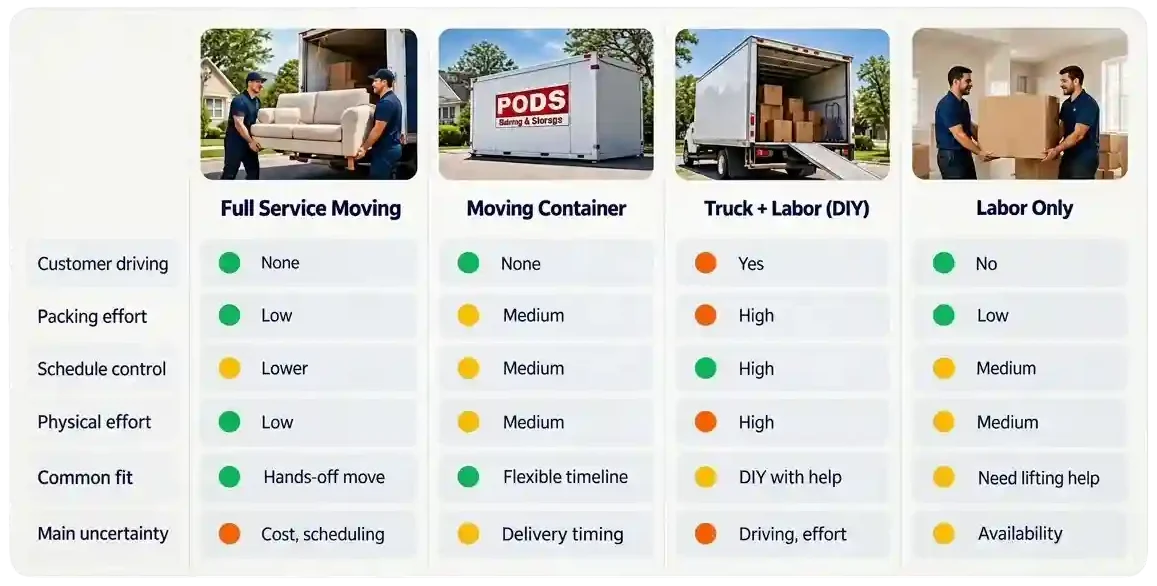
Compare how each moving method differs in driving, packing effort, schedule control, physical effort, common fit, and the main uncertainty to plan around.
| What to compare |
Full-Service Moving
|
Moving Container
|
Truck + Labor
|
Labor Only
|
|---|---|---|---|---|
| Customer driving | None | None | Yes | No |
| Packing effort | Low | Medium | High | Low |
| Schedule control | Lower | Medium | High | Medium |
| Physical effort | Low | Medium | High | Medium |
| Common fit | Hands-off move | Flexible timeline | DIY with help | Need lifting help |
| Main uncertainty | Cost & scheduling | Delivery timing | Driving & effort | Availability |
The experience can vary by provider, route, home, schedule, inventory, access conditions, and the specific services you select.
Different moves call for different levels of help, flexibility, and control. These common situations can help you narrow down which options are worth comparing.
If you would rather have a moving company handle the transportation and most of the heavy lifting, full-service moving may be worth comparing first.
See full-service moving →If you want more time to pack and load without driving a rental truck yourself, a moving container can provide a more flexible timeline.
See container moving →If you are comfortable handling the truck and transportation but want help with the heavy lifting, truck plus labor can give you more control.
See truck + labor →If you already have transportation arranged and mainly need help moving heavy items, loading, or unloading, labor-only help may be a useful fit.
See labor-only moving →The details of your move can change both the planning range and which moving methods are practical for your situation.
Local and long-distance moves can involve very different transportation and planning needs.
Full packing, partial packing, or DIY packing changes the amount of work and service involved.
More rooms and belongings usually mean more loading time, equipment, space, and labor.
Short-term or longer-term storage can affect scheduling and which moving method fits best.
Timing, lead time, and flexibility can affect availability and how much control you have.
Pianos, oversized furniture, fragile items, and other specialty pieces may need extra handling.
Stairs, elevators, long carries, parking, and building access can affect time and labor.
Packing materials, extra labor, disassembly, reassembly, and other services can change the plan.
Use these planning tools to estimate costs, organize your move, and narrow down which moving options deserve a closer look.
Clear answers about effort, flexibility, costs, and what to consider when comparing different moving methods.
Full-service moving typically requires the least physical work from the customer because the mover handles transportation and much of the loading and unloading. The exact amount of work still depends on the services you purchase, such as packing, unpacking, or specialty-item handling.
Review full-service moving →Container service generally focuses on delivering, transporting, and picking up the container rather than providing the labor to load it. Loading or unloading help may be available separately, so check exactly what a specific provider includes before comparing total cost and effort.
Review container moving →Yes. One common approach is to rent the truck yourself and separately hire moving labor for loading, unloading, or both. You remain responsible for the rental vehicle, driving, fuel, scheduling, and coordinating the labor.
Review truck + labor →Compare the total expected cost for the method you are considering, not just the starting price. Depending on the move, that can include labor, fuel, mileage, packing materials, equipment, storage, access charges, specialty items, and other services you choose.
Estimate moving costs →Start with the same factors for either move: distance, home size, timing, access, belongings, available help, and how much transportation responsibility you want. A longer route can make driving, fuel, storage, delivery timing, and provider availability more important parts of the comparison.
Build my move plan →No. MoverDude planning ranges are preliminary estimates intended to help you compare and plan; they are not binding quotes from a mover. A moving provider determines its own price after reviewing the details and services involved in your move.
See how cost planning works →Bring your route, timing, home size, and moving preferences together so you can focus on the options that make sense for your move.