

Full-Service Mover
- Convenience
- Very high
- Physical effort
- Low
- Control
- Moderate
- Scheduling flexibility
- Moderate
- Driving responsibility
- No
- Packing responsibility
- Optional
- General cost tendency
- Higher
Compare full-service movers, moving containers, rental trucks, labor-only help, and DIY moving so you can choose the option that best fits your budget, timeline, comfort level, and how much of the move you want to handle yourself.
The right moving option depends on your budget, distance, schedule, physical ability, available help, and how much control you want over the move.
Full-service movers are usually the best fit when convenience matters most and you want professionals handling the heavy work.
Moving containers can work well when you want flexible loading time while someone else handles transportation.
Rental trucks give you more control over the schedule and transportation, but you take responsibility for driving and much of the work.
Labor-only help makes sense when you can manage the transportation but want help with lifting, loading, or unloading.
DIY moving can reduce the amount you spend on professional services, but it requires more time, work, coordination, and available help.
See how the most common ways to move compare across convenience, physical effort, control, scheduling, driving responsibility, packing responsibility, and general cost tendency.
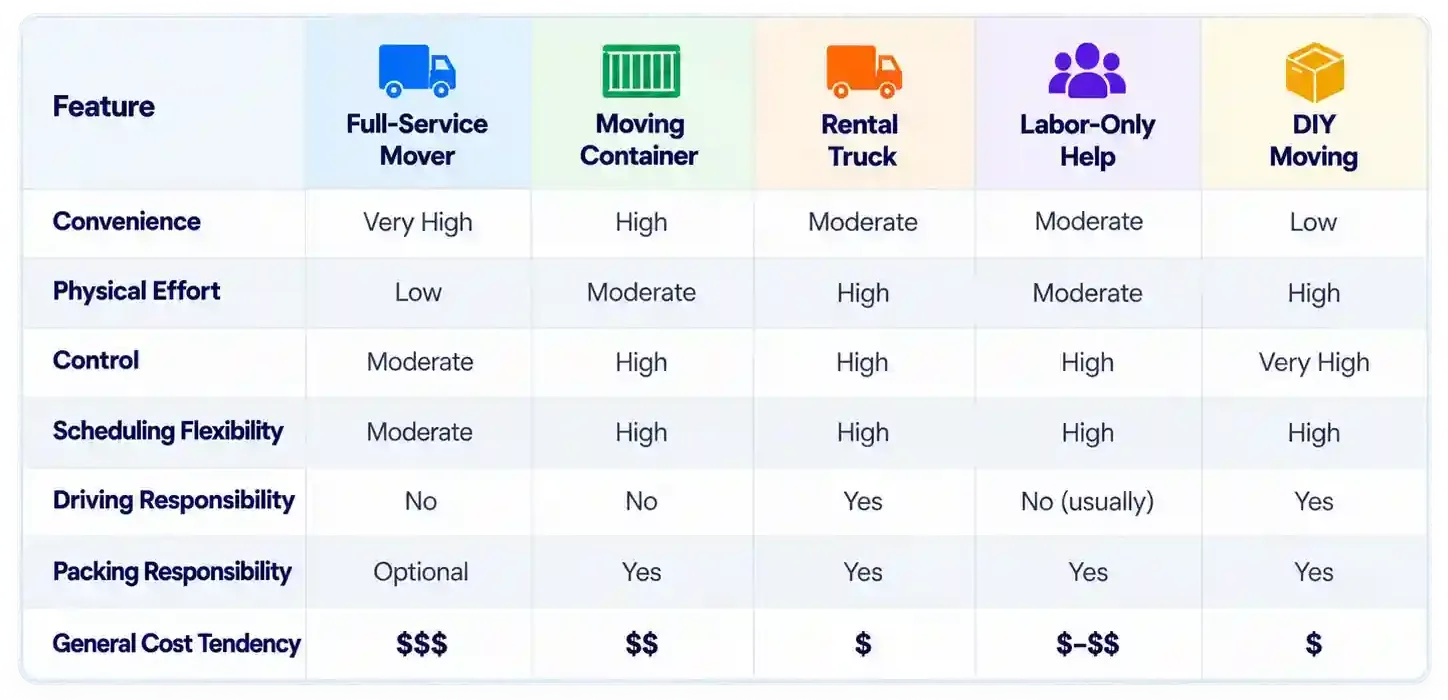
Use this as a starting point, not a price quote. Cost and effort can change substantially based on distance, shipment size, timing, access, services, available help, storage, and the specific providers or equipment involved.
*Driving responsibility depends on the exact setup. For example, labor-only help may be paired with a rental truck that you drive, while a DIY move could use a personal vehicle or another transportation arrangement.
Compare the major moving methods based on your distance, home size, timing, and how much help you want.
Each approach gives you a different balance of convenience, control, cost, physical effort, and scheduling flexibility. Compare what you handle yourself with what a provider handles before deciding what fits your move.
Movers handle the heavy work from loading through transportation and delivery. Depending on the service selected, packing and unpacking may also be available.
A container is delivered for you to load, usually on your own schedule. The provider then transports it to your new location or to storage.
You arrange and control the transportation while hired moving labor helps with loading, unloading, or both. You remain responsible for the driving.
Hire movers for the physical work without hiring them to transport your belongings. Labor can be used for loading, unloading, furniture moving, or other heavy lifting.
Compare the responsibilities, planning considerations, and tradeoffs side by side before deciding which approach fits your move.
The best moving method is not the same for every move. Your distance, home size, physical ability, available help, schedule, comfort with driving, and access at both homes can change which option makes the most sense.
A move across town gives you very different choices than a move hundreds or thousands of miles away.
A studio apartment, a two-bedroom condo, and a full house require very different amounts of equipment, space, labor, and planning.
Carrying furniture, loading a truck, using stairs, and spending hours packing can be demanding even when the move looks manageable on paper.
Friends and family can make a DIY move more realistic, while paid labor can fill the gap if transportation is already arranged.
Flexible loading can be useful when dates are uncertain. A tighter schedule may make professional help more valuable.
Rental-truck moves put the transportation responsibility on you, including navigating traffic, parking, fuel stops, and potentially long highway drives.
Stairs, elevators, loading docks, narrow streets, parking restrictions, long carries, and tight entrances can change the amount of time and labor a move requires.
If you do not want to drive, remove options that require you to drive. If heavy lifting is the problem, compare full-service or labor-assisted choices. If timing flexibility matters most, look closely at options that let you control when packing and loading happen.
Choosing how to move is only part of the decision. Distance, who you are actually hiring, how the estimate works, and warning signs from a mover or broker can all affect what happens next.
A move across town and a move across state lines should not be planned the same way. Distance can change transportation, scheduling, delivery timing, pricing structure, and which consumer-protection rules apply.
A mover and a moving broker are not the same thing. A mover transports household goods. A broker arranges transportation with a mover rather than performing the physical move itself.
A useful comparison goes beyond the number at the bottom. Look at what is included, what can trigger additional charges, and whether you are comparing similar services.
A low advertised price should not outweigh warning signs. Before hiring a mover or broker, make sure the company, paperwork, estimate, and payment requests make sense.
Interstate move? Federal consumer-protection requirements apply to interstate household-goods transportation. Intrastate moving requirements vary by state, so check the rules that apply where your move occurs.
There is rarely one moving option that is automatically right for everyone. These examples show how distance, budget, lifting ability, available help, and timing can point you toward different options worth comparing.
You have a smaller amount of furniture, the new apartment is nearby, and you have a full day available for the move.
If you are comfortable driving, renting a truck and hiring help for the heavy items can give you control without doing all the lifting. If convenience matters more, compare that against a local full-service mover.
You are moving a larger household across state lines and would rather not drive a large rental truck that distance.
Both options remove the need to drive the shipment yourself. The important tradeoff is whether you prefer professional loading and greater convenience or more control over your own packing and loading schedule.
You are comfortable organizing and packing the move yourself, but heavy furniture, appliances, or stairs make loading unsafe.
You can keep control of packing and transportation while hiring help for the physically demanding parts. Make sure the transportation plan, labor timing, and responsibility for equipment are clear before moving day.
Friends or family can help, your schedule is flexible, and keeping service costs down is one of your highest priorities.
Doing more yourself can reduce the amount of professional service you buy, but remember to account for rental charges, fuel, supplies, equipment, insurance options, time, and any paid help.
You have to leave your current home before the next one is ready and may need your belongings stored between locations.
A container can be worth comparing when loading, storage, and final delivery do not need to happen on the same day. Compare storage terms, access rules, delivery timing, and total charges before choosing.
Use these scenarios to understand the tradeoffs, then compare your own distance, shipment size, schedule, available help, access, and comfort level before deciding.
Use the tools below to compare moving methods, estimate planning costs, organize your inventory, estimate boxes, build your checklist, and plan the move in order.
Compare full-service, container, truck + labor, and labor-only approaches side by side.
Build a planning estimate using details from your move.
Organize the items and rooms that need to move before comparing options.
Estimate how many moving boxes you may need based on home size and belongings.
Keep planning tasks organized from the early stages through moving day.
Bring the planning steps together and work through your move in a more organized order.
Planning tools, not mover quotes. MoverDude tools are designed to help you organize and compare your move. Any planning estimate shown by MoverDude is not a binding quote from a moving company.
The right approach depends on the details of your move. These answers cover some of the most common questions that come up when comparing full-service movers, containers, truck + labor, and labor-only help.
There is no single moving method that is always cheapest. Doing more of the work yourself can reduce the amount of professional service you purchase, but the final cost can still include transportation, fuel, equipment, supplies, storage, insurance options, tolls, parking, and paid labor.
Compare the total expected cost of each realistic option rather than choosing only by the advertised starting price.
Estimate Your Moving Costs →A moving container may cost less than a full-service move in some situations because you usually handle the packing and loading yourself. That does not mean a container will always be the lower-cost choice.
Distance, container size, storage time, delivery charges, availability, access at each property, and optional labor can all affect the comparison.
Compare the Container Option →A rental truck gives you more control over transportation and can make sense when you are comfortable driving a larger vehicle and have enough help for loading and unloading.
Full-service movers can make more sense when you want to reduce the physical work, do not want responsibility for driving the shipment, or have a move where convenience and coordination matter more.
Compare your distance, shipment size, driving comfort, available help, schedule, and home access before deciding.
Compare Moving Methods →Labor-only moving help means hiring workers for physical tasks such as carrying furniture, loading, unloading, or moving heavy items without hiring that same company to transport your belongings.
It can be useful when you already have a rental truck, container, trailer, or other transportation arranged but do not want to handle all of the lifting yourself.
Explore Labor-Only Help →There is no required number that works for every move, but comparing multiple realistic estimates can help you understand the range of pricing and what different providers include.
Do not compare only the final number. Review the inventory, services, transportation responsibilities, packing, access-related charges, storage terms, and other conditions included in each estimate.
A dramatically different estimate deserves a closer look rather than automatically being treated as the best deal.
A moving company that acts as the carrier transports the household goods. A moving broker generally arranges transportation with another company rather than performing the transportation itself.
Before an interstate move, make sure you understand which business you are dealing with and which company is expected to transport your shipment.
The distinction matters because the responsibilities of the companies involved are different.
Start with your distance, shipment size, schedule, available help, driving comfort, and how much of the work you want to handle yourself.
Once you understand which moving option may fit your situation, use the next guides to organize the timeline, prepare for moving day, plan a long-distance move, and look for practical ways to control costs.
Work through your move in a more organized order with practical planning tasks for the weeks before moving, moving day, and the first steps after you arrive.
Learn what deserves extra attention when your move covers a longer distance, including transportation, timing, documents, inventory, estimates, and delivery planning.
Get the home, boxes, essentials, access details, documents, and final arrangements ready so moving day is easier to manage and fewer important tasks are left until the last minute.
Look for practical opportunities to reduce moving expenses without relying on unrealistic promises—starting with what you move, which services you buy, timing, supplies, and comparison.
Next, build your checklist, work through the timing, prepare for moving day, and use the long-distance or cost-saving guidance when those topics apply to your move.
Use what you have learned to compare the moving methods that realistically fit your budget, timeline, available help, physical ability, and transportation preferences. Then turn the decision into an organized moving plan.
MoverDude provides independent moving information and planning tools. Planning estimates are not binding mover quotes.